

Museum Archives: A Steyning Farm – and its dung – in the 18th century
Tuesday 1st August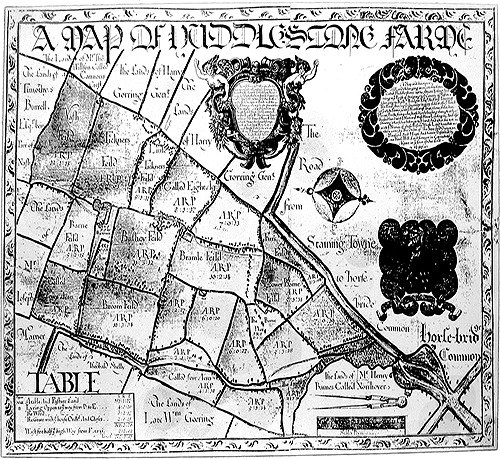 If you head up the road towards Ashurst you will come to a track on your right which follows the line of the Roman ‘Greensand Way’. It leads to Huddlestone Farm and, in the eighteenth century, if you had set off along this track, there is a very good chance that you would have passed a dung cart with an ox between the shafts and a farm labourer with his dung spud.
When an inventory was taken on the death of farmer Charles Groome, in 1757, he had four dung carts plus eight dung spuds used to dig the dung from one of the four large heaps of dung mix on his farm and to spread it on his fields. It was meticulously recorded that the six acre ‘Tickners Field’ had not only been 'twice plow’d and twice harrowed' but that they had then spread 'fifty-three loads of dung on the same'.
Even more effort had been put into the preparation of the eleven acre ‘Beech Field'; it had been 'four times ploughed and four times harrowed and one hundred and thirty two loads of dung spread on it'.
The soil in the ten-acre ‘Conduit Field’ appears to have been too acidic and merited different treatment. It needed 'three ‘kilns’ of lime' and 'sixty loads of mudd'. The lime was made by burning chalk and Charles Groome had a stock of 4,000 kiln faggots for that purpose together with hedgerow trimmings.
'Furze on the hill' was also valued but was used in the home rather than on the farm; it produced a particularly hot flame for baking.
The reference to 'furze on the hill' suggests that the farm included land on the Downs and this certainly sits well with the fact that the inventory listed 657 sheep, differentiated in all sorts of ways.
There were, for instance, fatting sheep, four teethed sheep, two teethed culls sheep, wether lambs, fatting lambs, six teethed wethers, fatting ewes, old ewes and ‘store’ ewes. The number of teeth were a measure of the age of the sheep, ‘culls’ were inferior animals from the flock which had been separated out for selling and wethers were castrated male sheep kept for their wool. ‘Store’ sheep were animals intended for fattening.
Cattle would seem to have been less important than sheep on Mr. Groome’s farm, though they no doubt contributed to the dung heaps. There were 52 animals in total, separated into bulls, cows, steers, great runts and little runts – runts in this case being a description of young animals.
On top of that there were 33 oxen. These were draft animals which would have been used for drawing ploughs, dung carts and the like. They would have been kept busy because, apart from the dung carts, there were four waggons, eight harrows and nine ploughs. Less information is provided, however, on the number of people needed to run the farm. The 'men’s room’ in the farmhouse had three beds and there was also ‘the maid’s bedroom’ but we don’t know how many men and women came in each day from their own cottages.
Charles Groome had died in August when the harvest was in full swing so some of his crops were measured in waggon loads. Two hundred and fifty acres were taken up with the growing of wheat, his main crop, and one hundred of these had already been harvested when he died. Seventy acres were fallow – those fields identified as having been ploughed and ‘dunged’ – and a further seventy were down to peas – a crop designed to put nitrogen back into the soil.
Yet another seventy acres were devoted to oats and beans (mainly for animal fodder) and to barley. Seven hay ricks were valued, but nothing was said about the acreage used as meadowland or pasture or its value.
It would seem as if it was only the output of the farm and the work put into it – and, of course, the dung – which were valued, and not the acreage as such.
Article by: Chris Tod - Steyning Museum.